Valley Stream

On Tuesday, March 30, early in the morning, I took the commuter train from Grand Central Station to Valley Stream, Long Island. The station was abustle, as it was every working day, with what one writer termed the “wage slaves” arriving from throughout the Metropolitan area to put in their eight hours of labor in the offices and skyscrapers of the great city. As the eternal outsider, I observed how most of the men were well-dressed, with suits and ties, leather shoes, the femmes in skirts and high-heels. The snack bars and newsstands were doing a lively business and there were always one or two people hovering around the Information booth in the center of the vast ground floor, as well as lines in front of the row of counters selling tickets to the outlying stations. There was a pleasant hum of purposeful, businesslike bustle, a tiny sliver of the daily weekday routine that embraced the working years and lives of millions who had not escaped from what some considered to be the “rat race”, the eternal striving for wealth and security. The scene at Grand Central brought to mind several old films in which the Station was used as a key scenario, such as The Clock with Judy Garland and Robert Walker, The House on Carroll Street and by extension, even the 1953 Italian classic, Vittorio de Sica’s Stazione Termini with Jennifer Jones and Montgomery Cliff. There was even for me a distant filmic whiff of that great British classic, Brief Encounter, most of which is set in a provincial station in England. 

(more…)
Abel’s Style Sheet

By Peter Besas                                      

Madrid, Sept. 13, 2023

As I was rummaging through piles of old papers and back issues of Variety in one of the rooms in my apartment, aside from chancing upon a playbill from Tony Pastor’s Theatre at 585 Broadway, with one of the dozen attractions being Miss Lillian Russell, and a 22-page 1912 program of the New Amsterdam Theatre on 42nd Street for a “musical comedy deluxe” called The Pink Lady that included display ads for such restaurants as Shanley’s on Broadway, featuring an “exceptional Cabaret”, Cavanagh’s Restaurant and Grill on 23rd St. (“vocal and instrumental music, shell fish a specialty”), Murray’s “Cabaret in Roman Gardens” on 42nd St., Wallicks new Broadway restaurant on 43rd St. and Bustanoby’s on 39th Street (dinner $1.50, Parisian specialties, dancing, select performance, Tel.6780 Greeley”, I came across a Style Sheet that the former Variety editor Abel Green had printed in 1960 for the guidance of old and new muggs.

(more…)

Variety Mines Archives for WB 100th Anni

By Robert Marich

April 8, 2023

Warner Bros. Studios ignites a wave of tributes on its 100th anniversary and no one is better positioned than Variety to tell the storied film giant’s history from its editorial vault.

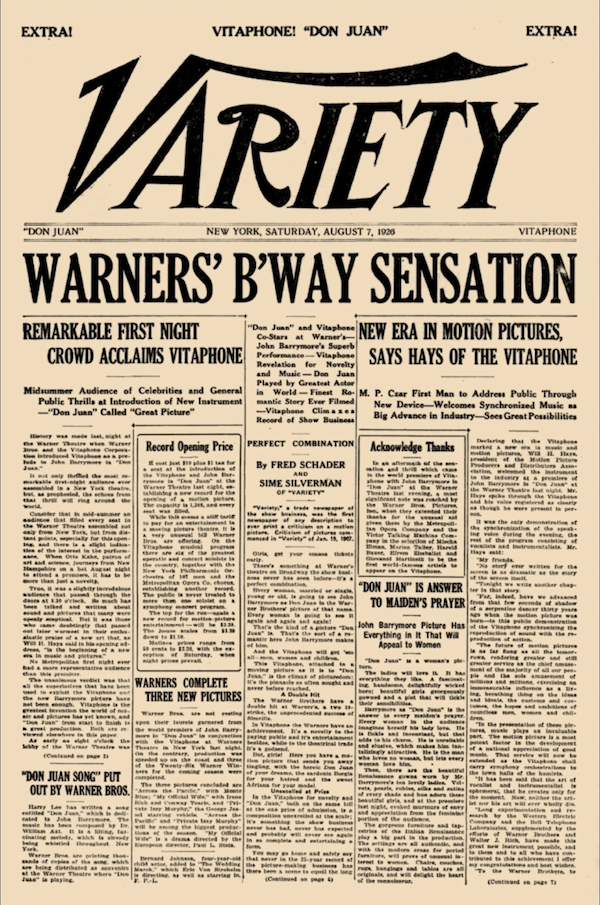
The front page of a special Variety edition dedicated to WB’s sound innovations in 1926’s “Don Juan”
(more…)

Variety Archive Illuminates Babylon Backstory

Los Angeles, Dec. 28

Variety reached into its expansive vault to provide real-life backstory to new theatrical film Babylon about Hollywood in the Roaring 1920s. The Variety archival article dated Dec. 23, 2022, plays off filmmaker Damien Chazelle’s new Paramount Pictures release starring Brad Pitt and Margot Robbie that captures and exaggerates that early period of “Hollywood in all its decadence, debauchery and excess.”

And Variety was there!

(more…)

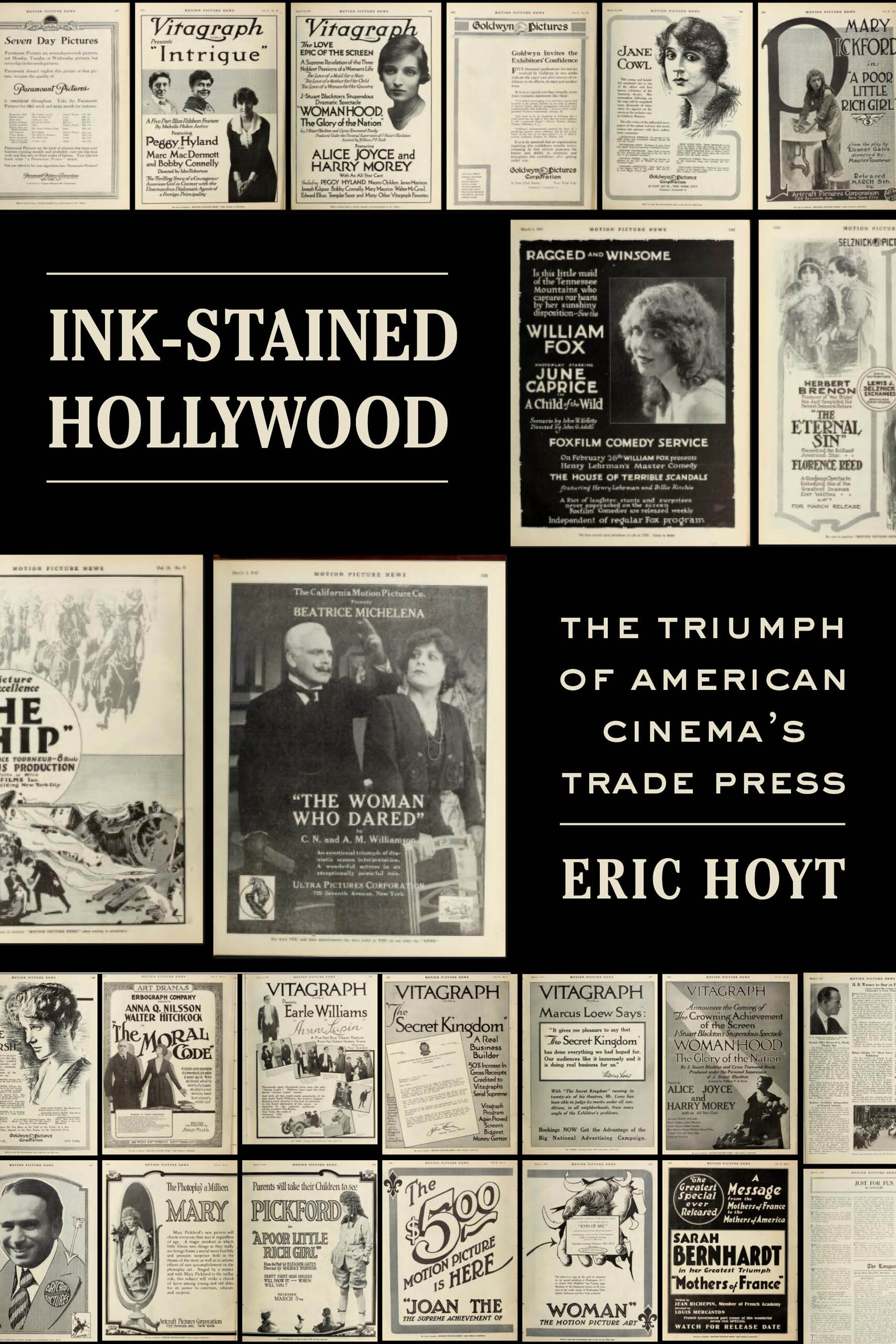
Ink-stained Hollywood

Madrid, May 14, 2022

For many decades, journalists at the old Variety office on West 46th Street referred to themselves as “ink-stained wretches” or “galley slaves”, self-mocking monikers that were prompted by the configuration of the elongated editorial room where they sat at their manual typewriters. At the head of the row of reporters, on a raised dais, next to the picture window that overlooked 46th Street, sat the publisher Syd Silverman and a series of editors-in-chief, though I believe they never cracked any proverbial whip over the “galley slaves”. The most famous of those sitting on the dais with Syd over the years were Abel Green, Bob Landry, Bob Hawkins, Mark Silverman and Frank Meyer.

The “ink-stained” monicker has now been used as the title of a new book that zeroes in on the early era of show biz jounalism called “Ink-Stained Hollywood: The Triumph of American Cinema’s Trade Press”. Its author is Eric Hoyt, a professor of Media Production at the University of Wisconsin, in Madison. and is published by the University of California Press.

Given the credentials of its author and the publisher, it is no surprise that this is a serious, academical work which does not shy away from analyses and historical details

To my knowledge, it is the first book published since my own Inside Variety (2000) that mentions some of Variety’s early protagonists, starting with Sime Silverman, but also referring to Daily Variety’s first editor-in-chief, Arthur Ungar, and others. In consonance with the title of the book, Hoyt concentrates mostly on film activities in Hollywood and when he writes of “Variety” it is usually Daily Variety that he is referring to, not the New York-based weekly.

However, a number of pages in the book are also dedicated to slanguage (Hoyt also uses the term “industry speak” which is a modern expression). His research has been thorough as he dipped into the trade press of the early part of the 20th century, and he even makes mention of the New York Clipper, a trade mag of the 1920’s which Sime acquired but then folded a year later. Also covered in the book is some of the infighting among the vaudeville moguls of the time.

If Hoyt’s book remains in the purely academical vein, eschewing any attenmpt at evoking the atmosphere of the early Variety years and the muggs that worked on it, it is notwithstanding a welcome, well-written addition to a subject – old show biz journalism – which seems to have been largely ignored since the publication of my own book. PB